Menu Close

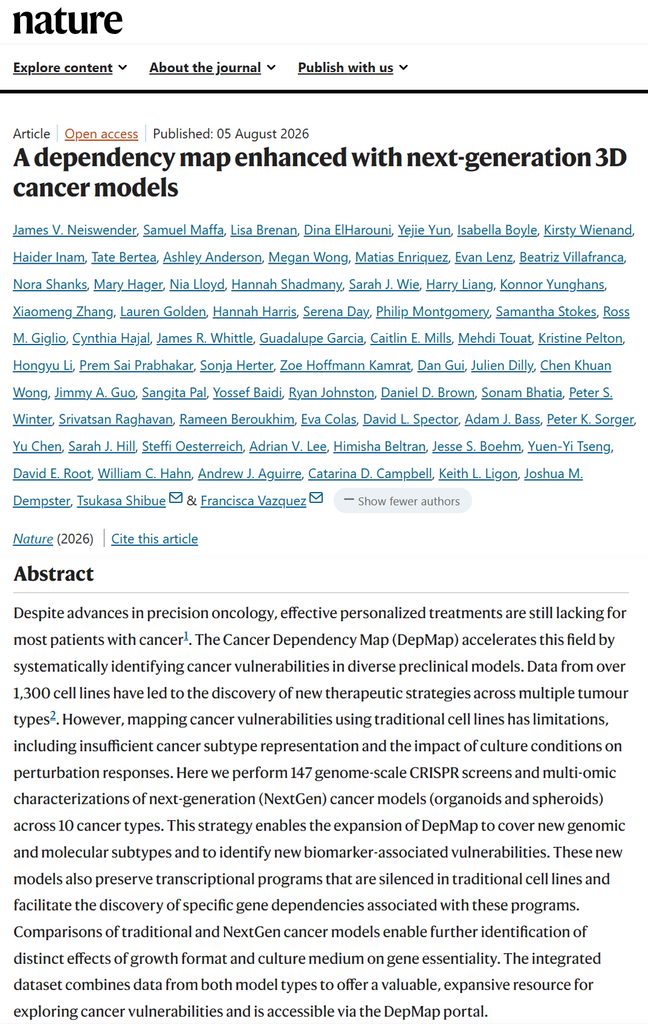
Congrats to Drs. Adrian V. Lee, Steffi Oesterreich, and Daniel D. Brown for their contributions to the latest Nature publication: A dependency map enhanced with next-generation 3D cancer models!

Congrats to Drs. Adrian V. Lee, Steffi Oesterreich, and Daniel D. Brown for their contributions to the latest Nature publication: A dependency map enhanced with next-generation 3D cancer models!
https://www.nature.com/articles/s41586-026-10843-7
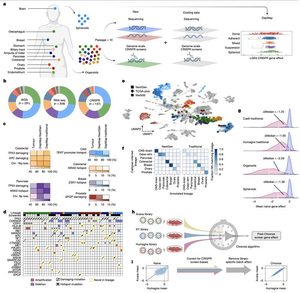
This work was a collaboration with the Broad Institute of MIT and Harvard. Breast cancer patient-derived organoid (PDO) models were developed by Daniel Brown in the Institute for Precision Medicine in collaboration with the Lee-Oesterreich lab, and some of these PDO models were provided to the Broad Institute. The Broad team ran genome-scale CRISPR screens across 147 organoid and spheroid models spanning 10 cancer types, expanding the Cancer Dependency Map (DepMap) into tumor subtypes traditional cell lines simply don’t capture. These models preserve transcriptional programs that get silenced in 2D culture (like the PDAC-classical/MUC program in GI organoids), and oncogene dependency itself can be model-dependent. Model choice shapes the biology we’re able to see.

This manuscript was one of three companion papers published together in Nature, all validating patient-derived 3D cancer models as the next generation of preclinical tools.

Our contribution to this work was supported in part by NIH R01CA252378 through the National Cancer Institute (NCI) Oncology Models Forum, grateful for that support in helping make this collaboration possible.

This seminal paper is published alongside two outstanding companion papers:
Herranz-Ors et al. (Wellcome Sanger Institute), “A tumour-derived organoid biobank maps cancer gene dependencies” — 256 clinically annotated organoids across five GI/gynecologic cancers, with genome-wide CRISPR dependency screens on 162 of them.

ElHarouni et al., “A compendium of next-generation patient-derived models for diverse cancers” — the Human Cancer Models Initiative’s landmark 665-model resource across 25 cancer types.

Together, these three papers make a compelling, converging case that organoids and related New Approach Methodologies (NAMs) can faithfully recapitulate tumor biology at a scale sufficient for systematic target discovery, not just as a nice complement to cell lines, but as tools that reveal biology cell lines miss entirely. That’s the bet we’ve made with the Organoid Research Core here at Pitt, and it’s exciting to see it borne out across multiple independent efforts at once.

A dependency map enhanced with next-generation 3D cancer models | Nature
A tumour-derived organoid biobank maps cancer gene dependencies | Nature
A compendium of next-generation patient-derived models for diverse cancers | Nature
Experts from the Institute for Precision Medicine spearhead groundbreaking discussions at the global PMWC 2025 conference

At the PMWC conference, Adrian Lee, PhD, Director of the Institute for Precision Medicine (IPM), chaired the Clinical Utility of Liquid Biopsies track, leading a critical discussion on “Improving Sensitivity of MRD and MCED – Tumor-agnostic vs. Tumor-informed ctDNA Approaches.” Joining him on the panel was Marija Balic, MD, ScD, MBA, (UPMC Hillman Cancer Center) co-director of the Magee Women’s Cancer Program and clinical co-leader of the Women’s Cancer Research Center (WCRC). A leader in breast clinical science, she oversees Pitt and UPMC’s breast cancer program.

The Institute for Precision Medicine at PMWC 2025

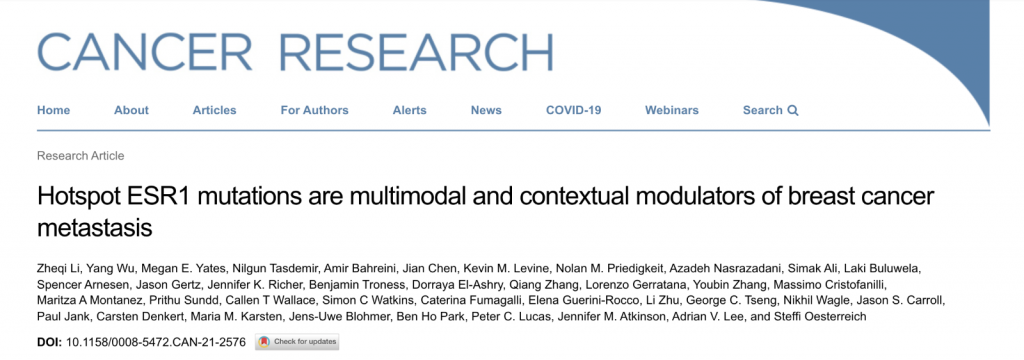
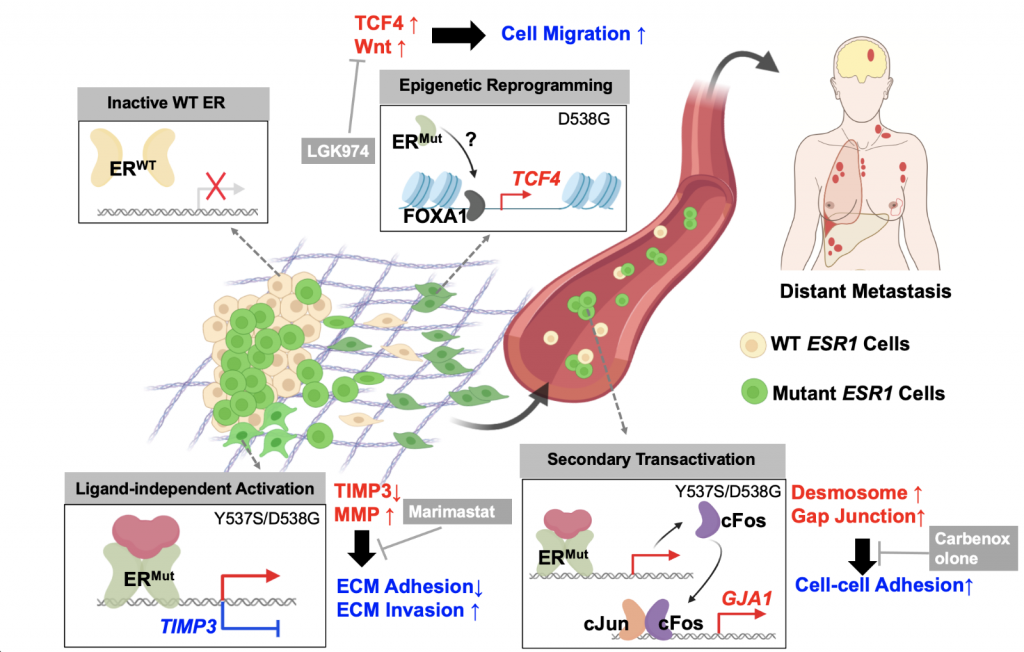
Our paper about ESR1 mutations and breast cancer metastasis is now published in Cancer Research! 

https://cancerres.aacrjournals.org/content/early/2022/01/25/0008-5472.CAN-21-2576
Zheqi (Vaciry) Li, Ph.D.

This study was led by former graduate student Vaciry Li with great efforts from many intra- and inter-group collaborations. Congratulations to all! 

In this study, we showed that context and allele-dependent transcriptome and cistrome reprogramming in ESR1 mutation cell models, which elicit diverse metastatic phenotypes related to cell-cell adhesion, cell-ECM adhesion and migration driven by increased desmosome/gap junctions, dampened TIMP3-MMP axis and Wnt pathway. Importantly, some of these pathways can pharmacologically targeted and reveals novel therapeutic strategies.  

Our new review is out now in The Lancet Healthy Longevity!

Led by PhD student Neil Carleton and senior authors Adrian Lee, Priscilla McAuliffe, and Steffi Oesterreich, we review key considerations for “right-sizing” therapy options for older women with ER+ breast cancer. With contributions from radiation, pathology, surgical oncology, radiation oncology, and medical oncology from the UPMC / Magee Women’s Hospital breast cancer group, this collaborative effort touches on optimizing quality of life along with new translational studies that may impact future treatment of these patients. 

Check it out at: https://www.thelancet.com/journals/lanhl/article/PIIS2666-7568(21)00280-4/fulltext.  

The Lee/Oesterreich lab receives two Breast Cancer Alliance Exceptional Project Grants!

The Lee/Oesterreich lab is delighted to receive two grant awards from the Breast Cancer Alliance (http://breastcanceralliance.org/).

The BCA selected to fund our projects entitled ‘Therapeutic targeting of novel pathways in breast cancer brain metastases’ and ‘Understanding the importance of ESR1 fusion genes in metastatic breast cancer”. The grants provide one year of funding support for these exciting projects.

We are very grateful for the funding to continue our quest to better understand and target endocrine resistant breast cancer.